

Previously, I laid out a A Grand Theory of Cybernetic Taste, building on the cybernetic theory of mind from the Slime Mold Time Mold team. I care about this because we need to understand taste better if we want to get people away from eating animals by getting them to eat new and tastier things. Having worked in the alternative protein industry, I think we can do better than the current paradigm of making (expensive) things and giving it to a few people to try before launching it unsuccessfully on the market.
Here is the theory so far.
There are many nutrients we need to survive, and we have governors (thermostats) for some of them that keep us in homeostasis by making us take actions. Individual nutrients don’t really exist in nature, most things come through food. The human body developed a bunch of sensors (smell, texture, etc.) to build a predictive model for what nutrients are in food. That model is taste. You eat spinach, your body detects iron hours later, and your taste model learns that spinach means iron. Next time you’re low in iron, the iron governor acts on your taste model to make spinach sound tasty.
Great theory, there are still some questions. We would want nutrient governors + an updating taste model to explain most of our experience of taste. But there are some problems.
Maybe the taste model doesn’t update?
The Shallow Diver handsomely asked on my last post:
Do we find lots of people who crave taking multivitamins? Mine definitely have a characteristic flavor and more iodine than a seaweed snack, but I’m oddly not interested in popping an extra one [...]. Am I a weirdo who is strangely immune to tasty multivitamins?
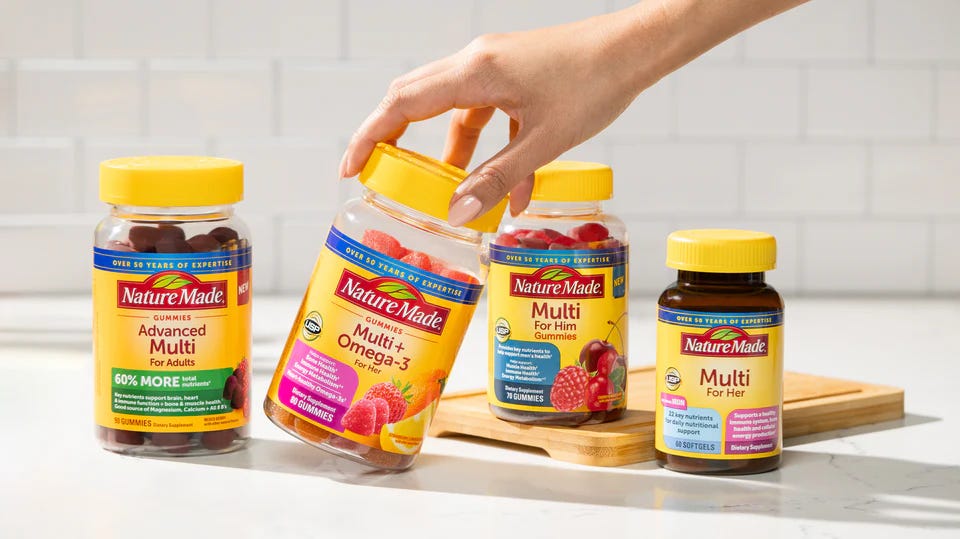
I think there might be a lot of things going on here. It could be that multivitamins just don’t work in delivering vitamins to the body (probably for some nutrients but not for all). It could be that there is too little sensory information from a small multivitamin for the taste model to learn on. It could be that there is an inherent bias in the brain of what food is, and a multivitamin just wouldn’t fit in that because we don’t see that kind of nutrient dense food in the ancestral environment.
I think you would need a competing theory of taste to explain non-updating taste. For instance, why is steak tasty? Intuitively it’s “because it is juicy and meaty and yum” but that feels circular. What I think you’d need to say is that taste is innate. Taste is inherent at birth, and there is a craving for juicy meat that we learned through evolution, and there’s no getting around that.
But I find this unsatisfying because taste is definitely adaptive. Different cultures have different tastes. Many people from Asian cultures don’t eat steak and kinda don’t like it when they’re exposed to it for the first time. What we eat as children definitely seems important, but I know from my experience being vegan that my tastes have significantly shifted from what I ate as a kid. Fish has remained a craving. To all my vegans in the comments, please sound off about what sticks around for you!
So in any case we need a theory for how taste adapts.
What’s going on with texture?
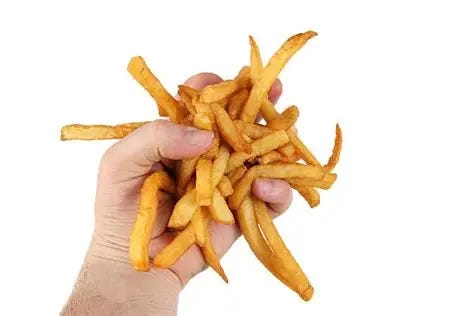
Fresh french fries are delicious. A crisp outside, a fluffy interior. But leave them for half an hour and they become cold, limp, and despicable. I don’t like cold french fries nearly as much. What gives? fresh and cold french fries have identical nutrition Why do I like one and not the other? We love crispy fried things more than greasy fried things. This seems like a strong and universal preference that cannot be explained by nutrients.
In parts of East Asia like Taiwan, they seek out the QQ texture. This is the squishy cloud-like texture of mochi. There are many ways to achieve this texture, what’s going on here? And why is it memetic? It doesn’t seem like nutrients have much to do with this at all. Also why do they all like it? Culture seems to be very important to the taste model. Maybe the governors for status or belonging also influence taste?
Then what is going on with chocolate? People love well tempered chocolate that is crisp and glossy, and dislike poorly tempered chocolate that is chalky. But they have identical nutrients. There might be some explanations by how it melts in the mouth, fat release, volatilization of compounds, or some other receptor contact.
What in god’s name is going on with plant-based milks??
This to me is the largest problem with the theory if we want to take it anywhere. Plant milks make up something like 15% of sales now, they are by far the most popular product category to have come out of the vegan product space.
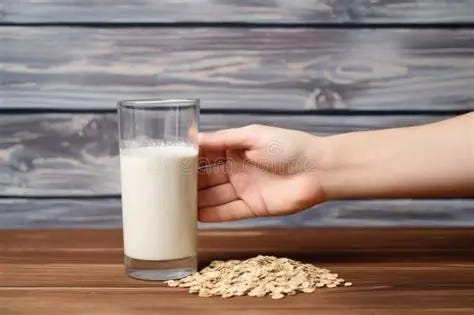
But plant milks, especially oat, are nutritionally devoid*. They are textured water. But sometimes I kinda love an oat cortado. People explain it by saying there are a lot of lactose intolerant people that switched over, but I don’t find that satisfying. Why would they crave the frothiness of a cappuccino in the first place if they weren’t reaping the benefits? Why am I craving the frothiness of a cappuccino?
Please send more problems with the theory
I will provide research directions for what we should do in a future post. But we want this theory to be robust. Please give feedback on any other holes you see, then let’s falsify it!
*Exception for soy milk. It totally makes sense to love soy milk. Soy is perfect human food.
For me, aged cheeses are still a thing I crave. Absolutely no vegan cheese comes close to an aged Gouda or parmesan.
As for things that taste better hot than cold--OMG Beyond burgers SUCK when cold--suddenly they change from being creepily too close to meat in both mouth-feel and taste, to being utterly pasty. It's like Cinderella's coach turning back into a pumpkin (though not nearly as yum).
And absolutely our taste morphs and changes. I used to be a sweet breakfast person and then switched over to my husband's salty pastas, and can't believe I ever pounded granola, which now tastes like eating a snickers bar with (oat)milk. And mochi--no thanks--not while I still have teeth in my mouth!