

Here are a bunch of projects I would want to start that I will not start because I’ve got a bunch of shit going on.
The Vegan Menu Project
Every restaurant should have a separate physical menu or QR code that takes you to an online one, showing everything that is or can be made vegan. This would essentially be making a way better version of happy cow. I have a whole step-by-step plan of how you would do it here.
This is easy with AI:
Scrape the menu photos off google maps
Parse the menus to get all the items
Figure out which items are vegan using an LLM
Create a mobile app where power-users can verify that items are vegan or not
Once you have all the vegan items confirmed, ship them the menu
Catalogue every vegan product
Historically this has been difficult but Claude will be able to automate a lot of this. The best current effort we have is Vegan Action which does the vegan certifications, but many products do not want to be certified vegan. Many products I buy are not listed.

No oreos on your list! That’s a problem.
You’d want to capture as many products as possible, starting with major grocery chains and online stores. You can inspect ingredient labels to work this out with AI tools. Or you can just access Open Food Facts or similar databases to get information directly and filter.
Is It Vegan almost does this, you can scan something and it tells you if it’s vegan. But they don’t expose their proprietary database. Boooooo!
If you were smart, you could sell this as labeled data to these same stores to allow for customers to filter! They might pay good money for that.
Quality control
Last year I had a post Every vegan product I shoved in my mouth in February 2025. While flippant, I think the point stands that there are a ton of quite bad products out there, and this should be recorded somewhere.
Nectar is currently the main group doing reviews. But they are doing thorough sensory panels, which doesn’t scale to every product. And they anonymize the products.
My basic take on sensory panels is that most people you do not need statistical signal to know when products are bad. Get 3–5 people with representative palates, sit them down, and have them eat it. You could even calibrate this small panel against Nectar’s results. At minimum, we’d have a record of what’s really bad. And there’s a lot.
When companies and startups want to take new products to market, there should be pressure to submit it to this review panel first.
Sunsetting bad vegan products
Products have gotten so much better over the last 10 years, but there’s still a lot of bad stuff on shelves. The Trader Joe’s vegan sausages, for instance, are terrible and actively harming the movement. I’ve always found this strange since their other vegan products are so good. People don’t judge vegan food by the best we have to offer. Someone gets curious, picks something random off the shelf, and bases their judgment on that. For that reason, it is very important that every product on the shelf is good.
Nectar’s data shows a large gap between the best and average product in each category, meaning a lot of products are dragging the average down.
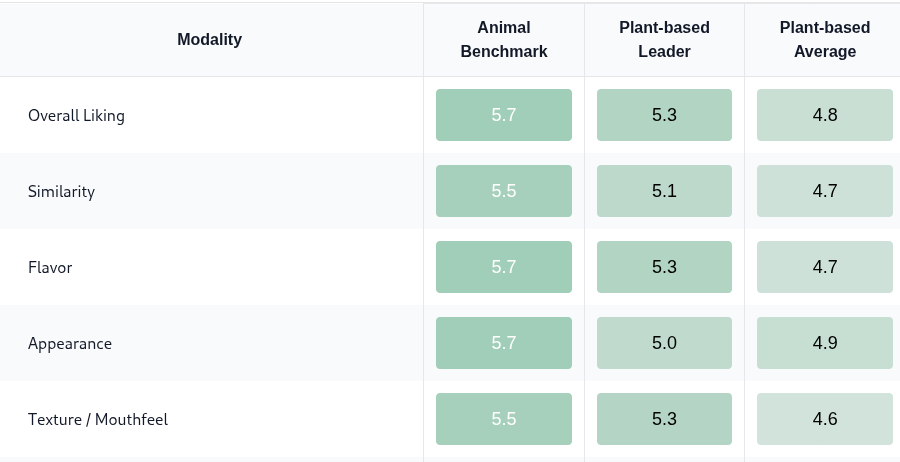
For whatever reason, the market isn’t fixing this on its own. The Trader Joe’s sausages keep selling. There are vegan protein bars at Whole Foods that omnivores find inedible. There are many explanations for this:
Distributors bundle products together, so bad ones ride on good ones
Companies sell many flavors or similar products together, only some of which are good
The industry optimizes for vegans rather than omnivores
Vegans and omnivores have different taste preferences. We should only be selling products in the overlap of that Venn diagram, and there are plenty. We’re a little bit too nice to each other, unfortunately. We’re all on the same team, so it feels bad to tell someone to stop when they’re trying to bring something to market, but I think that’s what we need to do.
The two main things to do here are:
Stop people taking bad new things to market
Make sure the new products that startups and larger companies are making get sent through the centralized quality control. If it fails, inform investors and who they’re trying to sell to. It is harsh but will be healthier for the industry in the long run.
Sunsetting
We need to get how to get Trader Joes to stop selling their sausages, for instance. This could be using networks in vegan media, social media influencers, etc. This is one area where we have a surprising amount of influence.
That’s the stick. On the carrot end, we should be ready for them with better comanufacturers. There are a lot of good sausages out there!
Vegan products without borders
When traveling I find great products that aren’t available in the US, usually only in their home country. Australia has great products that aren’t available here, like this chocolate spread. Germany has great cold cuts. The list goes on. Things are localized, and it’s hard to go international, so there should be a concerted effort to find the good ones and help them scale.
The project would be to identify the best products globally, then help them scale, license, or get duplicated for other markets.
Anthony Bourdain for Veganism
We need a charismatic vegan travel show, much higher quality than what’s on YouTube now. Most are the same cookie cutter of ticking off all the vegan restaurants in a city they travel to and have to put out constant stream of content garbage.
We need well-researched episodes where someone goes to a city or country, and gets to the core of that culture’s relationship with vegan food. Countries have incredibly rich vegan food histories, and there will be a good way to bring that out. At the very least we will uncover more foods that we can spread around.
Trader Joe’s invests heavily in cultural food discovery and it pays off. I’m suggesting we do our own version, popularize it with media, and focus on dishes and products that can spread globally. There’s a lot out there to be found.
Get into the Chinese restaurant supply chain
Note: I would be surprised if someone hasn’t tried this, and would be interested to hear why it hasn’t worked.
In Sydney, the Chinese restaurant scene universally adopted dumplings stuffed with fried eggplant that are very popular. For the standard restaurants most people eat at, there is a supply chain at the core that decides what is made.
The majority of Chinese takeout restaurants in the US are very similar to each other. They have similar menus, and use the same suppliers. We now have products good and cheap enough to put a few vegan proteins on every menu, and this would require figuring out how to get into this system. I suggest a concerted effort: work with a local Chinese restaurant to see what the form factor would be the easiest to get into their workflow, and what would be popular.
Copy-paste for other cuisines.
Ok if we ever go to china, I'm willing to forgo one historic site (which is my first priority!) for
going out of our way and finding some unknown local vegan dish, that sounds so fun!